
| revista.la@nebrija.es
| ISSN 1699-6569
| Semi-annual publication
Manuscript Review Process
Contents of this page
Review Steps
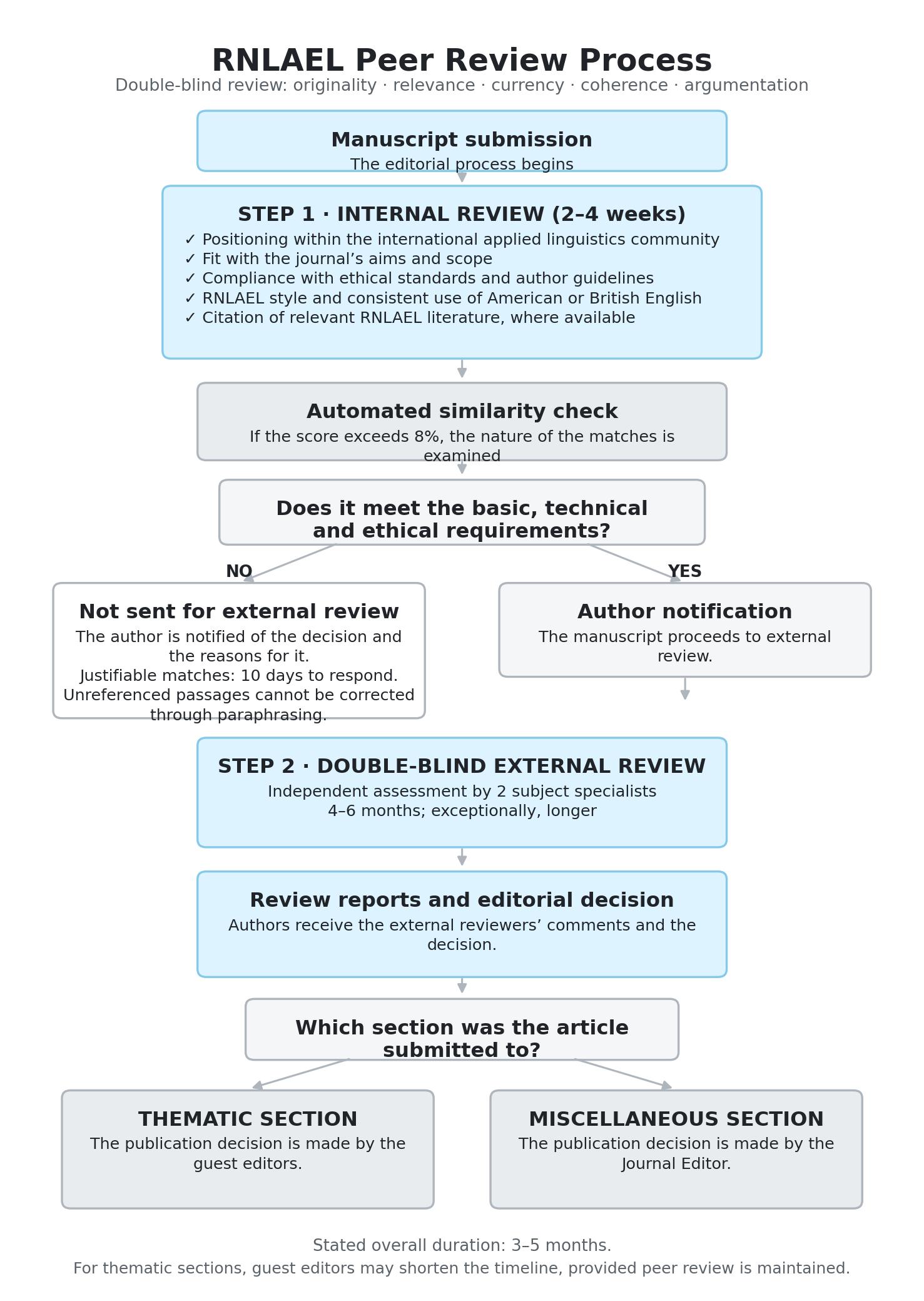
The peer review process can take anywhere between 3 to 5 months. The aim of the review process is to identify the strengths and weaknesses of the article, in terms of originality, interest, up-to-dateness, coherence, and argumentation. As such, all manuscripts submitted to RNLAEL go through a two-step double-blind peer review process. In the thematic section, with public call for papers, guest editors can shorten review times but peer review is maintained.
Step 1-Internal Review (2-4 weeks)
Prior to the allocation of manuscripts to peers for external doubly-masked peer review, we read each manuscript; this is done so that we can decide if the manuscripts we receive:
- have been appropriately situated within the context of the international community of applied linguistics;
- fit within the scope of the journal;
- are adequate in terms of their adherence to RNLAEL codes of conduct and author guidelines;
- have followed editorial style and have cited papers from the back issues of this journal (available free of charge from RNLAEL repository).
In this phase, the editor(s) of the journal review(s) each manuscript to see if it meets the basic requirements for articles published in the journal. Technical checks will also be made to see if manuscripts follow RNLAEL Editorial Style, RNLAEL style sheet, American/British English Usage, and other RNLAEL standards (especially ethical ones). Manuscripts which do not meet these requirements are not sent out for further review, and their authors will be notified. The texts are also subjected to an automated plagiarism check and in the case of a score of more than 8%, they are returned with 10 days for the author to justify the coincidences (in the case of well-referenced quotations, for example) or without the possibility of correction by paraphrasing or reworking in the case of sentences from non-referenced sources.. The internal review may take anywhere between 2 to 4 weeks.
Following the internal review, authors are notified by e-mail as to whether their manuscript has been sent out for external review or not--and if not, why not.
Step 2-External Review (4 to 6 months)
Following the internal review, submissions which meet the basic requirements and the bottom-line standards set by RNLAEL are sent out for doubly-masked peer review (by 2 experts in the field). On rare occasions, this second review step may take up to 6 months or longer. Following the external review, the authors are sent copies of the external reviewers' comments and are notified of the decision.
Following the external review
After the external doubly-masked peer review of a manuscript, the corresponding author will receive an email in which she/he will be informed of the status of the manuscript. Review judgments can be Accepted, Accepted with minor changes, Significant changes requested or Rejected.
What if revision is required?
In most cases, RNLAEL reviewers recommend that authors revise their manuscripts and send their revisions to RNLAEL for further processing. In such cases, authors may want to accept some of the comments and suggestions that have been made by the reviewers, and at the same time refute some others. It is strongly recommended that authors send in a 'rebuttal' note (in the form of a Microsoft Word file named 'Rebuttal.doc' or 'Rebuttal.docx') in which they respond to reviewers' comments and suggestions item by item. They should clearly show which comments and suggestions they accept, and which comments and suggestions they refute. Where a comment or suggestion is refuted, the author is expected to provide the reason why.
Important Notice
This electronic 'rebuttal' note should be strictly anonymous; authors should not identify themselves in this note or in the filename used for the manuscript.
Workflow
Basic guidelines for reviewers
If you are a reviewer and would like to find out more about the process of submitting your review on this platform, please read these instructions.
You can submit your comments offline using the following form. However, when you are ready to upload them to the platform, the system will ask you to answer further questions, in particular to summarise your overall assessment in accordance with the review criteria. You will be able to upload the form you have previously completed in that section. You will find all these tools on the dashboard of this platform once you have accepted the review.
Single-Rejection Policy
RNLAEL adopts a single-rejection policy: a manuscript may be rejected if the relevant editor or one of the reviewers identifies, with supporting evidence, an ethical breach, an irremediable methodological flaw, an insufficient contribution, or a clear lack of suitability for the journal’s scope, even if other reviews are favourable.
Complaints procedure
This procedure applies to complaints concerning the journal’s policies, procedures or editorial staff. The journal welcomes complaints that may help improve its processes and is committed to responding promptly and constructively.
Complaints:
- must be submitted to institutional adress;
- must concern matters within the editorial team’s responsibility, such as excessive delays, inappropriate responses or serious errors of judgement;
- will initially be handled by the appropriate member of the editorial team and referred to the Editor-in-Chief when necessary;
- may be escalated to the Editor-in-Chief if the initial response is considered inadequate. The Editor-in-Chief’s decision will be final within the journal;
- may subsequently be referred to an external body, such as the Committee on Publication Ethics (COPE), if the complainant remains dissatisfied with the final decision.
All complaints will be formally addressed within seven working days of receipt.


